[tintuc] The fourth Industrial Revolution (Industry 4.0) is changing the way products are created by spreading digitized manufacturing/processing and automation. We have seen the benefits of automation over decades and are now adding enhanced data, machine learning and artificial intelligence to the mix. Today, autonomous systems are more interconnected, communicating, analyzing and interpreting data to let managers intelligently decide and act in other areas of the factory.

Smart factory initiatives create business value by increasing output, asset utilization and productivity. They leverage new data streams to improve flexibility and quality while reducing energy consumption and  waste. Increasingly, edge-to-cloud connected networks let factories increase efficiency through mass customization.

The goal of Industry 4.0, much like IIoT, is to increase the amount of usable data and improve decision making. Timely access to data and its delivery depends on networks. Networking technology, along with manufacturing processes and methods, must advance to handle more dataIntelligent, interconnected automation requires connected machines collecting and sharing information. How these machines and factory communicate through networks makes Industry 4.0 possible.

The need for seamless connectivity from every sensor and actuator across the factory, even those in remote locations, is impossible within the existing infrastructure. The challenge is finding how to handle unprecedented volumes of data without crippling the communication network designed to transmit it. This raises the question of how to build and deploy industrial communication networks to meet the needs of today’s automation environments and tomorrow’s virtual factory floors.
Why Deploy Industrial Ethernet?

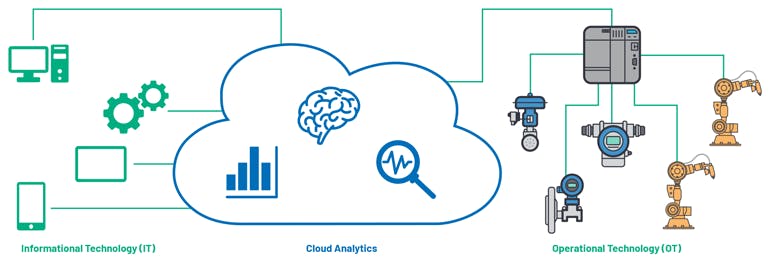
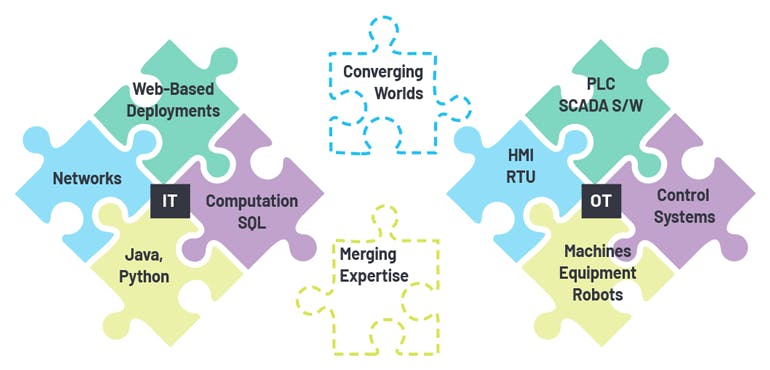
Connectivity is central to Industry 4.0, but three things must happen before there are truly connected companies. First, higher-level information technology (IT or enterprise infrastructure) must merge with the plant floor operational technology (OT and the control network). Secondly, manufacturing cells on factory floors must interoperate. Thirdly, there must be seamless, secure connections from the edge of the process to the cloud.

To address these challenges, industry must adopt networks that support interoperability, expandability and reach. Ethernet seems ideal, being well understood and widely used in most factories. It also has high bandwidth and can be put in place relatively quickly.

However, Ethernet is not suited for industrial control given the need for real-time operations. Control networks must send information where and when it is needed to ensure the tasks are processed correctly. The TCP/IP protocol for routing traffic does not guarantee this level of performance. In the same way standard Ethernet lets users share files and access network devices such as printers, Industrial Ethernet lets controllers access data and send instructions from PLCs to sensors, actuators and robots on the factory floor.

The key difference between the two is the impact of delayed and undelivered messages. In non-real-time applications, if the webpage updates too slowlyeffects are minimal. In manufacturing environments, however, effects can be more harmful—from wasting materials to injuring workers. For control systems to work, messages must get to their destinations reliably and on time, every time.

As a result, Industrial Ethernet has emerged as the technology of choice at the control level of the operating technology. The goal is to connect IT and high-level operation networks, as well as connecting the layers of the factory’s operations network to end-node sensors and actuators (see illustration below).
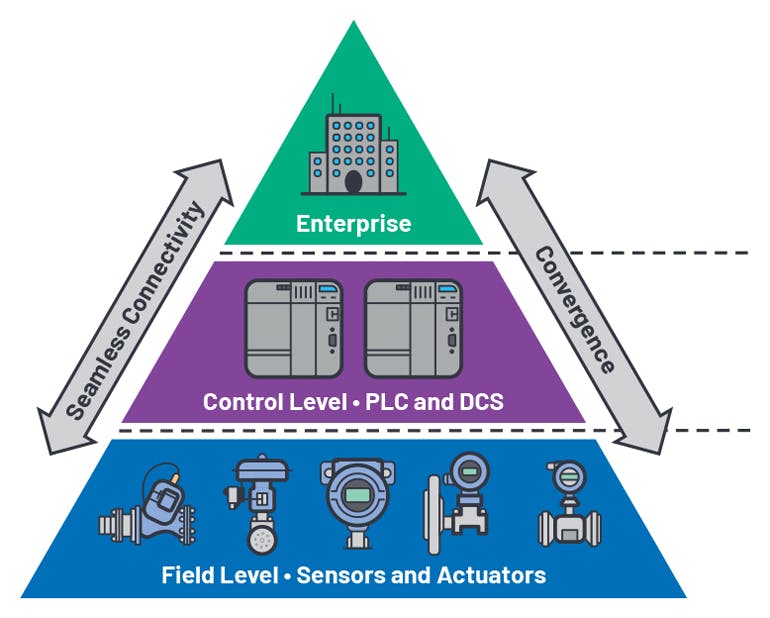
Today, complex, power-hungry gateways are required to connect manufacturing cells to Ethernet at higher layers where the converged IT/operational technologies are required. Having plant-wide, interoperable automation network based on Ethernet would eliminate the need for these gateways, thereby simplifying the network.

In fact, protocol gateways that translate and connect to the operational network’s upper layer are not directly addressable and create information isolation within the network. This data isolation limits the ability to share information across the factory . This is contrary to a vision of Industry 4.0 in which manufacturers want to collect telemetry data from the operational side to drive analytics and business processes on the IT side.
Control applications need predictability in packet delivery and timing guarantees. So, many vendors tried to provide real-time protocols for operational networks. This resulted in solutions that, while predictable, were specific to each vendors’ protocol. This, in turn, led to lots of different incompatible communication protocols running in different manufacturing cells. This perpetuates data isolation, or data islands. Different manufacturing cells running different protocols must share the network in a way that guarantees control traffic is not compromised.

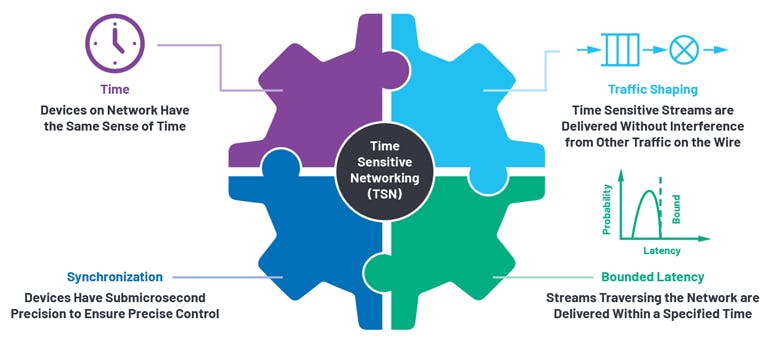
The answer is time sensitive networking (TSN)a vendor-neutral, real-time Ethernet standard based on the IEEE 802.1. As the name implies, TSN focuses on time. It transforms standard Ethernet communication into a process that guarantees timing for mission-critical applications. It makes sure information moves from one point to another in a fixed and predictable amount of time. This is how TSN guarantees timely delivery.

For communications to be predictable, network devices must share a concept of time. The standard defines how to transmit certain TSN Ethernet frames on a schedule, while letting non-TSN frames be transmitted on a best-effort basis. This is how TSN handles real- and non-real-time traffic on the same network. All devices share the same time, so data can be transmitted with low latency and jitter at gigabit speeds.

The goal is a converged network, where protocols each share the wire predictably and reliably. TSN’s tools provide the predictability. It represents the transition to a reliable and standardized connectivity architecture, eliminating data isolation through proprietary fieldbuses. This convergence of networks will drive data generation through the network’s growing scalability across bandwidths from 10 Mbps to 1 Gbps and beyond.

The likely scenario is that TSN will be adopted throughout new installations, but incrementally in cells or segments within facilities. For field-device manufacturers, this means Industrial Ethernet and TSN must be supported for the foreseeable future.

Connecting the Entire Enterprise

Our final and perhaps most important change is building seamless connectivity from the edge node to the enterprise cloud in process control applications (see graphic below).

To date, connectivity to the edge has been limited by the 4-mA to 20-mA or fieldbus technologies. These hardwired point-to-point connections restrict the network ‘s flexibility to grow and change over time.

These non-Ethernet-based communications face several challenges. First, bandwidth such as 1.2 kbps for HART on 4-mA to 20-mA limits information flow’s amount and speed. Second, limited power delivery to the instrument restricts is functionalityFinally, the gateways at the control and IT level are an unsustainable overhead. There is also the challenge of operating in intrinsically safe Zone 0 and using existing cabling network to support faster, less-expensive commissioning.

These challenges necessitated development of IEEE 802.3cg-2019, a standard for 10BASE-T1L, full-duplex communication. It was recently approved and specifies 10 Mbps full-duplex communication with power over a single twisted-pair cable up to 1-km long.

Data starts in the sensor as an Ethernet packet and goes to the operational network and IT infrastructure as an Ethernet packet. There is nneed for translation, which creates delays and costs, and consumes power. Existing networks will change, with remote I/O units going to Ethernet field switches.

Ethernet instructions can be sent to and from the controller through 10BASE-T1L multiport field switches to and from field instruments. Insights generated at field nodes can be sent via Ethernet packets (with higher bandwidth) through the field switch network to PLC/DCS controllers and, ultimately, to the cloud.

Several advantages will drive the move from legacy fieldbuses to Industrial Ethernet. First, the potential to reuse existing cabling (up to 1 km in lengthsimplifies deployment and reduces retrofitting costs. Second, power delivered over the cable to the equipment was confined to 36 mW (best case, with 4 mA to 20 mA deployments). It will be free to go up to 60 W (cable dependentor 500 mW in Zone 0 applications.

The extra power lets equipment handle higher functions with end node intelligence. This, and the 10 Mbit uplink speed now available, will provide increased insights in how to capitalize on Industry 4.0’s promised efficiencies.

What’s Available Now?

Durable, low-latency, low-power equipment with scalable switching is needed for automation networks to advance. To support next-generation applications, Industrial Ethernet-manufacturers are developing silicon and software to ensure time-critical data is reliably delivered throughout industrial applications. For example, ADI Chronus from Analog Devices provides embedded switches and multiprotocol software that are fully tested and verified for fast times to market.

  • Notable solutions within Chronous include: 10 Mbps/100 Mbps Industrial Ethernet PHY with improved features and durability.
  • The lowest latency, lowest power gigabit PHY that withstands harsh environments. The fido5200/fido5100 a real-time, embedded, two-port, multiprotocol switch that supports many TSN features.
  • New TSN features can be added via firmware updates that become available. Multiprotocol software updates are also supported and available through the developer’s portal.

To support the transition and provide a bridge to legacy field devices, a software configurable I/O (AD74413R) from Analog Devices lets users develop field-configurable remote I/O units that handle communications between legacy machines and higher- level Ethernet networks.

What About Security?

Ethernet has vulnerabilities, and security is a critical one that is slowing adoption of Industry 4.0. With an open flow of an enterprise’s information between operational networks and IT and from the edge to the cloud, the aftermath of security breaches could be devastating.
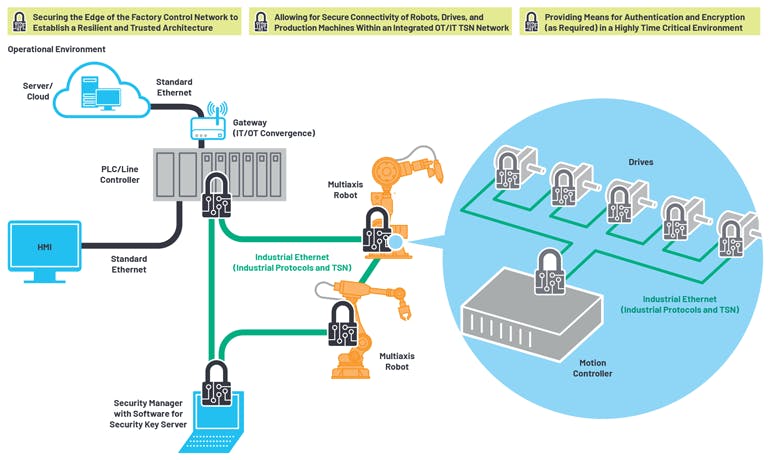
Security should be a fundamental risk-management concern in planning an Industry 4.0 strategy. Building security into increasingly complex networks is not easy. It must be a multilayer approach that makes its way through the entire system—within edge devices, controllers, gateways and further up the stack. With silicon and software becoming available, OEMs can offer security at each node point in the system while minimizing trade-offs in power, performance and latency.

The Roadmap to Deployment

Although Industrial Ethernet has seen considerable growth in recent years, fieldbuses and other legacy networking technologies are still being deployed. The advantages of converged networks based on Industrial Ethernet include a simplified network architecture, cost reduction by removing gateways, improving system optimization and increasing up-time. The advent of new standards and their imminent ratification is the catalyst needed to accelerate this awaited transition.

This is a transition firmly driven by the need for better-performing connectivity networks with increased integration between OT and IT. TSN is the vehicle to deliver a converged network and, when married with 10BASE-T1L, will enable seamless edge-to-cloud connectivity. The migration will not happen overnight, but the potential benefits are so compelling that it is likely adoption will outpace standard industrial norms.

At the heart of the Industry 4.0 vision is the ability to automate processes using connected devices with the capacity to collect, send and receive information. New technology is unlocking the data and insights previously unobtainable from many edge-node devices. It is opening the doors to better data analysis and operation insights. Industrial Ethernet connectivity will awaken this reality through the seamless transfer of current and future data streams across the automation network to the cloud.

There are data islands of information and insight we cannot access today, but as Industrial Ethernet deployment becomes the norm, the challenge for Industry 4.0 will move to security and what to do with all this data to maximize our business value.

[/tintuc]

[tintuc]Robotic welding or automation is welding process is basic need or current technological era when every machine need  precise finishing. When we talk about the welding suddenly a picture appears in our mind that it is the process of joining two metal parts. But to have a better understanding of the topic, welding is not limited to metal and ceramics only. It is also used in the plastic industries for the same purpose to join the two plastic parts.

In manufacturing, the term joining and the assembly comes frequently,

Joining

it is commonly used for welding, brazing, soldering, and adhesive bonding to get the assembled entity. This assembled entity is joined permanently and it is difficult to separate it. Joining is one of the most important process of the mechanical industries (aerospace ,automotive , oil and gas). Let us consider oil and gas industries what will happen with oil and gas if the tank is and pipe is joined by some other mean instead of welding, brazing and soldering.

Assembly

It is the manufacturing process of joining two parts into a single entity using nut, bolt, and fastening and these methods gives the flexibility to dissemble the entity into individual parts. It is very progressive way of joining the parts together. In the floor of manufacturing the assembly lines are sequential organized whether it man power , tool, machine and parts to be assembled. To understand the importance of assembly, let us consider that the whole car parts is join by welding and you want to change the cylinder from the engine?

Welding

Welding is the process of joining two individuals parts at the contacting surfaces by using the heat or pressure or filler material and combination of it. Some of the welding processes are achieved by pressure or heat alone. The filler is an Extra material that is used in the welding to make joining strong. The welded parts are called weldment.

Why we require Robotic Welding or Automation in welding?

As we are well familiar with automation, it is the process of doing something efficiently without human intervention. At the same time, it is also very important to know why do we automate the welding process.

automation in welding
                                                               Robotic Welding in a Car Industry

Safety and health

It was found that in the welding process that it produces hazardous gases that affect the life of the welder. Generate particular fumes,  noise, toxic gases and a certain range of electromagnetic radiation which varies from ultraviolet to X rays. In addition to these methods related to hazard. There is also risk associated with application constraints. If the project of shipyard then it is very difficult for welder and associated team to work underwater and a risky as well. So to overcome with all these applications constrain automatic welding offer to perform all these projects efficiently without compromising the welding quality.

Product quality

Manual welding does not give efficient and accurate weldment that leads the further process to find out the irregularities, gap, and defects in the welding to achieve the quality and standard set by the client and at last, the whole process consumes more time and capital.

Supply

It is very clear that the production of the product directly depends on the manpower skills and the understanding of the process. Many of the research reports found that the demand for skilled welder increasing gradually but there there is not enough skilled welders who can perform the work within the given span of time. Automation in welding is classified as-

  • Machine welding
  • Automatic welding and
  • Robotic welding

Automation options:

Welding automation gives a very vast configuration of the system from simple arrangements to the fully integrated systems some of them are as mentioned below-

  • Simple mechanism
  • Customize and dedicated automation.
  • Robotic welding
  • Modular automation
  • Programmable control
  • Remote control slave.
  • Simple mechanism Robotic welding
  • An industrial robot is not a humanoid welder.

It is a programmable device specially designed for both manipulate and transport parts and tools through variable program motion to perform the specific task of the manufacturing. As far as welding robot concern tool or specialized manufacturing implementation is grouped of welding head wire feed and tracking device. Here wire a filler material which is feed into the joint to make the welding strong. The tracking system gives direction to the robotic movement. robotic process are now used in many of the welding processes that includes – GMAW, FCAW, SAW, GTAW, plasma, resistance spot, and laser welding, etc.

Components of the robotic welding are asleep follows:-

  • Manipulation arm
  • Welding package
  • Control system
Manipulation system

Mechanical manipulation system that gives the common configuration of manipulating and the most common is articulated arm usually having six and more axes of movement and the benefits of this articulated arm are its degree of freedom and flexibility to reach the narrow access area.

There are many systems to drive the robotic arm by the pneumatic, hydraulic and electrical actuator is used for the movement of the arm. Hydraulic power systems are recommended in this because it has to carry the high load more than 35 kg. If this is used for resistance spot welding then the speed must be limited. Now in most of the fusion welding, DC servo motor drive is being used.

Welding package

The welding package basically depends on the welding operations being used. It varies process to process

  1. Resistance welding

It is known for pick and place type welding application. Welding head is brought by the robot at the joint location that is being welded.  Electrode palaces near on the joint and the welding is being performed. Once the welding done robot moves the next position of the welding and the same is repeated until the desired operation performed.

  • Laser welding

Please keep in mind that robotic welding has not changed the composition of the welding it has just the way of the process and eliminates the direct Human interaction. So in the laser welding, everything would be as the traditional welding like co2, etc.

Control system

As the name itself says what control system does. It has the following task to perform-

  • Provide program storage
  • Interface with the operator
  • Control the welding package
  • Control the welding head position.

Mechanized/ machine welding.

In this welding, process adjustment can be done during the welding process. In this process the welding is being perform under the supervision of the operator. Basically the welding is achieved by moving the welding head mechanically with respect to the stationary work or by moving work and stationary welding head.

Automatic Welding

Adjustment during the welding is not at all required. Everything is being set and programmed prior to the process start there is no need to have someone for supervision. A person is deployed just to oversee the process and detect the variation from the set condition or normal condition.

I think we late to know the welding mechanization because the pipes welding expert are using these technologies since the 1960s and the TIG welding process still use more or less manual intervention.

Once the welding is done there is the number of inspections methods is being implemented to check the quality of the welding by automation or robotic way of inspection. [/tintuc]

 [tintuc]

The world is undergoing the most profound industrial transformation in more than 100 years. As a result, manufacturing has become a key topic attracting widespread attention globally.

Professor Klaus Schwab, author of The Fourth Industrial Revolution, points out that we are currently in the midst of Industry 4.0. Looking back at history, the First Industrial Revolution took place in the late 1700s, driven by the invention of the steam engine. The Second Industrial Revolution emerged in the early 20th century with the widespread adoption of electrical power. The Third Industrial Revolution, following World War II, was marked by the rise of automation based on computers and electronic systems.

As an inevitable progression, the industrial revolution we are experiencing today—Industry 4.0—is being driven by advancements in smart manufacturing, robotics, artificial intelligence (AI), and the Internet of Things (IoT). This transformation is shaping the future of manufacturing through five major trends:

1. 360° Manufacturing Technologies

New technologies enable companies to design, simulate, and validate production scenarios in virtual environments. For example, manufacturers can simulate product design and assembly lines before actual production begins.

By digitally simulating the manufacturing phase, companies can significantly reduce production time while ensuring that processes operate exactly as planned.

At Flex, advanced digital solutions are being used to provide remote support, allowing teams across the globe to collaborate and solve technical challenges in real time. Engineers in China, for instance, can consult with experts in the United States and receive fast, intuitive feedback through Augmented Reality (AR) glasses, accelerating problem resolution while substantially reducing travel costs.

2. 3D Printing Technology

3D printing represents a major milestone in modern manufacturing, enabling the seamless creation of physical products using a single tool.

This technology enhances design flexibility and optimization. For example, a component that traditionally requires six separate parts can now be produced as a single integrated structure, eliminating additional processes such as welding or fastening.

3D printing also reduces material waste through efficient material usage and recycling, while significantly shortening lead times. Its applications span a wide range of industries—from consumer products and toys to advanced medical devices—making manufacturing more agile and cost-effective.

3. Automated Manufacturing Systems

Automation is another critical pillar of the future of manufacturing. At Flex, approximately 50% of production processes are already fully automated.

Automation delivers higher precision, consistency, and productivity, and can operate effectively in harsh or hazardous environments that are unsafe for human workers. Next-generation robots are becoming increasingly user-friendly, equipped with voice recognition and computer vision capabilities to perform complex human-like tasks.

One key advantage of robots is reliability—they execute instructions precisely, without deviation.

4. Smart Factories Powered by Cloud Computing

Beyond robotics and virtual reality, manufacturers are rapidly adopting cloud computing and smart sensors to build intelligent factories.

Smart sensors can convert data into standardized metrics, communicate with other machines, store operational data, provide real-time feedback, and automatically shut down equipment in the event of anomalies to ensure safety.

Through IoT connectivity, manufacturers gain access to accurate, real-time data that supports informed decision-making. Combined with customer feedback, this data has a significant impact on research and development (R&D), enhancing user experience and accelerating innovation.

5. The Rise of Robotics—Still Human-Led

As production environments increasingly integrate robotics, virtual technologies, and advanced data analytics, a critical question arises: What role will humans play in Industry 4.0?

Despite concerns that machines may replace human labor, most automation technologies are designed to handle tasks that are unsafe or inefficient for humans. Rather than replacing people, robots serve as tools that enhance human capability and productivity. Skilled workers are still essential to supervise, manage, and optimize these systems.

Similar to the transition from agricultural labor to factory work in the early 20th century, Industry 4.0 will require new forms of employment across nearly all sectors. The future workforce must include professionals capable of developing hardware and software, designing automation systems, building and maintaining robots, and—most importantly—adapting to and managing advanced technologies.

[/tintuc]

products

BCM Industry is focusing on desgining and mnanufucring the machines and automation system using in steelworks are based one smart manufacturing solution. You can find the details of our products and services at below link

introduction

BCM focus on developing the solutions machines and automation targeting for a smart manufacturing based on digital transformation. BCM is a unit of BCC, manufacture and provide the below products and services:
  • Designing and manufacturing machine and autmation system for using for Overlay welding works
for more details click here

Video

-->
+84-898-471122